When a16z Says the Middle Is Over, What Does That Mean for You?
The assumptions underneath your business model might be past their expiration date.

David George at a16z published a piece a few weeks ago that landed like a grenade in a lot of group chats I’m in. The title: There Are Only Two Paths Left for Software. The thesis: either you are accelerating — shipping AI-native products, growing north of 60% — or you are restructuring for extreme profitability, targeting 40%+ free cash flow margins. Everything in between is no-man’s land.
It’s a sharp piece. Worth reading. And the advice is sound if you’re running a venture-backed SaaS company with a board that’s benchmarking you against the Bessemer Cloud Index. But the part that stuck with me wasn’t the two paths. It was what sits underneath them.
The Question Nobody Wants to Update
Every company — startup, small business, nonprofit — is built on a set of assumptions. How your customers buy. What they’ll pay. What it costs you to deliver. What “good enough” looks like in your market. Those assumptions were true when you made them. The question George is really asking is whether they’re still true now.
And it’s worth being honest about this: a lot of them probably aren’t.
Per-seat pricing — the foundation of basically every SaaS company built in the last fifteen years — is under real pressure. When one person using AI tools can do the work that used to require three seats, the math that underpinned your revenue model starts to wobble. Chargebee’s research found that 37% of SaaS companies are planning pricing model changes in the next twelve months. I can confirm that with conversations that are happening within the Operators Guild, where founders and operators are sharing the same pattern. That’s not a trend. That’s a reckoning.
Meanwhile, AI-first products are running at roughly 52% gross margins — compared to the 75-85% that traditional SaaS companies got comfortable with. The cost structure has shifted underneath the business model, and a lot of founders haven’t fully reckoned with what that means for their unit economics.
This isn’t abstract. This is the spreadsheet or model you’re not updating.What If Everything You Built For Changes?
Here’s the question that keeps showing up in my conversations with founders and operators:
What if the way our customers buy fundamentally changes in the next eighteen months?
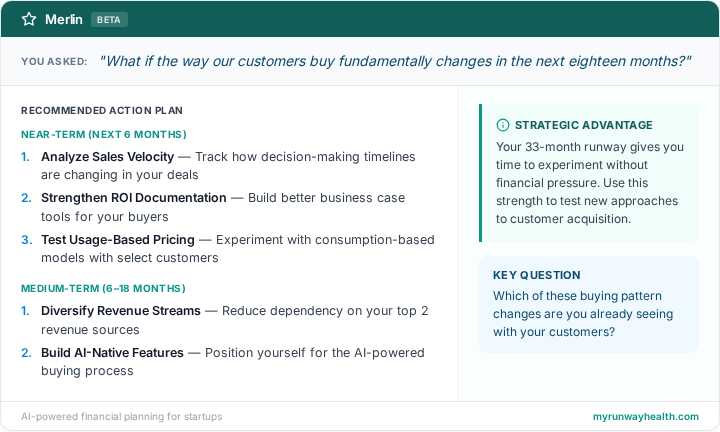
Actual output from Merlin, the AI financial engine inside MyRunwayHealth.
That’s not a hypothetical. Buying processes are already being reshaped by AI. Procurement teams are using AI to evaluate vendors. Experienced operators are comparing your product against what they can build themselves with off-the-shelf AI tools. Decision-making timelines are compressing — or, in some cases, evaporating entirely because the buyer just built a “good enough for now” version over a weekend.
George’s framework gives you two doors. But before you pick one, you need to answer a more basic question: does the business model you’re running still reflect the market you’re in?
The Board Problem (and the Investor Blind Spot)
This is where it gets uncomfortable for companies that have raised capital.
The VC ecosystem doesn’t just fund companies. It shapes them. The playbook that comes with institutional money — hire fast, capture market share, optimize unit economics later — was designed for a world where software moats were durable and switching costs were high. That world is eroding.
And the board dynamics that come with that playbook can make it harder, not easier, to adapt. When your investors are benchmarking you against a model that assumes 18-month sales cycles and enterprise stickiness, it’s difficult to raise your hand and say, “I think we need to rethink the whole go-to-market.” Even when that’s exactly what needs to happen.
The companies that navigate this well will be the ones where the board and the founders are asking the same hard questions — not the ones where the board is pushing for growth metrics that no longer map to how the market actually works.Do You Still Need a CTO? (A Controversial Sidebar)
One of the long-standing truths of SaaS startups — especially in the eyes of investors — is that you need a technical co-founder. A CTO. Someone who can build the thing.
I think that assumption is worth revisiting too.
Don’t misunderstand — technical depth still matters. But what “technical” means is changing fast. A founding team with strong product instincts, a clear vision for the user, and the ability to leverage AI development tools can now move at a speed that would have required a 10-person engineering team three years ago. The question used to be “who is writing the code” — when now it may be more of who is asking the right prompts, who understands the user deeply enough to direct the build, and who can iterate on a living product without a six-month development cycle.
There is a striking example of this from a completely different field. A Harvard physics professor recently used Claude — the same AI tool I use to build parts of our own product — to compress what would normally be a one-to-two-year graduate-student-level research project into about two weeks. His takeaway wasn’t that AI replaced expertise. It was that domain knowledge and judgment — knowing what questions to ask, and catching when the AI gets it wrong — mattered more than ever. The “technical skill” just shifted from doing the work yourself to directing the work and verifying the output.
That maps directly to what I’m seeing in startups. The founders I’d watch aren’t necessarily the ones with the deepest technical pedigree. They are the ones who understand their customer so completely that they can use every tool available — AI-native or otherwise — to close the gap between insight and product. That’s a different kind of technical. And it might be the kind that matters most right now.So What Do You Actually Do?
If George’s piece made you uncomfortable, good. That discomfort is useful. Here’s what I’d suggest:
Go back to your business model. Not your P&L — your actual model. The assumptions about who buys, why they buy, what they pay, and what it costs you to deliver. Write them down. Then ask yourself which of those assumptions were validated more than six months ago and have not been tested since.
If your answer is “most of them” — that’s your starting point.
The companies that come out of this period strongest won’t be the ones that picked the right door from George’s framework. They’ll be the ones that had the discipline to question whether the building they are standing in is still structurally sound.
When’s the last time your company actually interrogated its own business model — not the revenue line, but the assumptions underneath it? I’d love to hear what you’re seeing. Drop a comment or hit me up directly.
Related: There Are Only Two Paths Left for Software — David George, a16z
Reference: Vibe Physics (Anthropic Research) — A Harvard physics professor used Claude to compress a 1-2 year grad-student-level research project into 2 weeks.